Friday, January 16, 2015

DEPRESSION AND THE SECRETS THAT SHOULD BE REVEALED

9 secrets I've uncovered about depression

My relationship with depression is a complicated one. I have, clinically speaking, been grappling with it since I was a teenager; I was diagnosed for the first time at 15, and then again in my early twenties, and then again by my current therapist a little less than a year ago. The question of how long I've known I suffered from depression, however, is where things get a little hairy — I thought it was laughable at 15, and considered it a misdiagnosis at 20. It's only in the last year that I've really looked the thing in the face, accepted it as part of my life, and started to consciously do the work involved in keeping it under control.

A few weeks back, I wrote an article here on Vox about the 9 things I wish people understood about anxiety. I was comfortable writing that piece, because after a lifetime with generalized anxiety disorder and five years actively wrestling with how best to manage it, I feel like I really understand anxiety: its ins and outs, its ups and downs, the shape and size of the thing. I like to think that some day, I will be able to write that sort of article about depression. I like to think that some day, I will know this piece of myself that well.

Today, however, is not that day. Depression and I are in a much more tenuous place with one another. I am still learning its landscape, and it is still surprising me, tripping me up, and shaking the foundations of things that I once thought I knew. I can't tell you what I wish people understood about depression because I myself don't fully understand it yet, and I can't imagine delineating a list that I myself am still struggling to learn. So, instead, here are nine secrets I've uncovered about depression in experiencing it, which no one told me about, and which I never could have anticipated going in. They may not be secrets to everyone, and I hope they don't stay secrets to anyone for long, because knowing each one of them has helped me through this process.

1) Depression is a liar

If I had the power to put anything on television, it wouldn't be a channel that showed nothing but Boy Meets World reruns. It wouldn't be a ticker that ran along the bottom of the screen during sporting events with the text of the Harry Potter novels in it, so that those of us who hate football would have something to do in sports bars. No, it would be a 15-second spot, airing during every single commercial break on every single channel, that said: "If you have depression, it is lying to you." Because it is. Every moment of every day, in your waking and sleeping hours, depression is telling you lies.

Here is a small sampling of the lies depression has told me over the years: you're lazy. You're worthless. You're never going to amount to anything. If you ever do amount to anything, it will be a complete fluke, and not the result of any work, skill, or talent on your part. Your family hates you. Your friends hate you. Your family and friends don't hate you, but they would, if they knew what you were really like. You're rotten. You're stupid. The very core of who you are is garbage. The people in your life would be better off without you. The world at large would be better off without you. Nothing you do matters. Nothing you say matters. Nothing at all matters, except how terrible you are, which matters more than anything else could ever matter. You suck. You suck. You suck.

Today — to be strictly accurate, at the moment of writing this article — I know that these are lies. I know that they're lies because I've spent a lot of time in therapy learning that they are lies, and that depression is a liar, and that the things your brain spits at you when it's in a depressive period are lies the vast majority of the time. But when I'm depressed, I really, really believe these things are true. In fact, if during a future depression I were to come back to this article and stare at it, I can promise you I would think, "What was I talking about? Those aren't lies — in fact, that's the truth. The idea that those things might not be true — that's the lie."


2) Depression is a bully

It's a sneaky, manipulative bully. Not only that — it's a sneaky, manipulative bully that knows all your weaknesses and tender spots, and has at its disposal an arsenal of every uncomfortable moment, rejection, embarrassment, and emotional wound you've ever sustained in your life. It is, to put it simply, that kid who throws rocks at other kids on the playground.

I was lucky enough to grow up with two emotionally intelligent parents. They taught my brothers and me that bullying, more often than not, comes from a place of unhappiness. And of course depression is, in a number of ways, unhappiness given a name and a medical classification — it makes sense that it would have so much in common with that type of personality. But the thing about bullies is that the common wisdom about them often proves false. "Sticks and stones might break my bones, but words will never hurt me," for example, has been thrown around for generations, but most people I know (myself included) would happily trade a wallop with either object for the erasure of certain words from our personal histories. Likewise, the "just ignore it" theory, regularly presented as the solution to a bullying personality, is virtually useless advice when it comes to fighting depression. Depression does not want to be ignored; it wants to be in charge, and it will take advantage of any opportunity to gain ground. Left unchecked — indeed, ignored — depression can sneak and manipulate its way into the deepest recesses of your brain, becoming that much harder to eradicate.

Which is why:

3) If you think you might be depressed, you have to tell somebody

I know, I know — this isn't a secret. You've heard this one before. So have I: as part of anti-suicide campaigns, or scrawled at the bottom of pamphlets with things like "There Is Hope For You" written on the cover. I have to mention it anyway, though, because of the thought I've always had in response to the "tell somebody" advice: "It doesn't apply to me."

See, one of the complicated things about depression is that it comes in a variety of types and severities. The most visible types are the ones that can put people at high suicide risk: severe bipolar disorder — which can jerk people from manic highs to frightening lows — or an intense bout of clinical depression, which might drop someone so deep into what I think of as "the pit" that without seeking immediate help, they could be in very real danger of hurting or even killing themselves. And, of course, if you suspect that you or a loved one are at high risk for self-harm or suicide, you should absolutely tell someone at once. I don't for a second mean to suggest that that isn't the case. Tell your family! Tell a therapist! Don't tell me — I'm just a girl on the internet with some lived experience, and I make no claims of being a professional — but definitely, definitely tell someone.

Having said that, though, for a lot of us, depression isn't — or at least doesn't feel like — something that makes us high-risk for suicide. What I have, for example, is moderate clinical depression, linked in to my generalized anxiety disorder. It's the kind of thing that might slow me down or even stop me in my tracks, but it's never pushed me to a place where I was in danger of seriously harming myself. And that fact — the fact that I'm not thinking about killing myself any time soon — has, more than once, given depression an avenue to keep me from getting help. It has allowed thoughts like, "You're not depressed enough for it to really count," or "This is something you should be able to handle on your own," or, "Nobody wants to be bothered with your problems," or, "When they say you should tell someone if you think you're depressed, they're not talking to you."

I am here to say: if you think you might be depressed, then I am talking to you. Whether mild, moderate, or severe, depression is not something you should be trying to handle on your own. That's not, by the way, because you're not strong enough, or smart enough, or anything enough to deal with it by yourself — it's because depression distorts your thinking, and to sort through something that distorts your thinking, you need help that does not live inside your own brain. You need an ally that your depression does not have the power to affect. You need an objective party, and when you are depressed, thinking about yourself in an objective way becomes incredibly difficult.


4) Suicidal thoughts aren't always part of depression, and even when they are, they're not always active suicidal thoughts

An active suicidal thought might look something like this: "I wish I was dead, so today/tomorrow/next week/next month, I'm going to overdose on enough pills that I don't have to continue being alive." Active suicidal thoughts involve intent, even if it's intent to do something a long time from now. They involve a plan, even if it's a vague plan. They're what people think "suicidal thoughts" mean, and they're not wrong, exactly. It's just not the entire definition.

The other variety of suicidal thoughts looks more like this: "I'm going to go to sleep, and I hope that I don't wake up tomorrow," or, "Man, if I just jerked the steering wheel a little to the left, my car would flip over the highway partition and I could stop living — wouldn't that be nice?" These are what are called passive suicidal thoughts; there's no real intent behind them, and there's not necessarily a concrete plan involved. They are, in essence, fantasies about dying, which crop up because depression has made the idea of dying more appealing than the idea of continuing to be alive. I won't lie here, though I'd honestly prefer to: though I've never been in danger of truly harming myself, I've experienced passive suicidal thoughts alongside depression many times over the years. This type of thought is not as dangerous as the active type, of course, but that doesn't mean that it's not dangerous, because the one can lead to the other. Enough passive suicidal thoughts, built up over time, can become an active one.

Having said that, depression is often reduced — even in the minds of the depressed — to, essentially, the suicide disease, and that's neither accurate nor helpful. Some of us never experience suicidal thoughts at all; some of us have only ever experienced the passive ones I just mentioned; some of us have experienced active suicidal thoughts, but they've been few and far between.

Regardless of the volume of these thoughts, treating a friend or loved one who has told you they are depressed like they are automatically a suicide risk is often a mistake. For one thing, if a depressed person knows you are worried about that, they may be afraid to talk to you, or think that mentioning it would be burdening you, in the event that those thoughts do crop up. And, of course, there is the fact that the person underneath the depression — the person that depression is lying to, bullying, and bossing around — is probably very, very frightened of both the idea and the reality of suicidal thoughts. Having a part of your brain wishing you would die, whether actively or passively, is really scary, and it can be incredibly exhausting to have to comfort others on that subject when you're already struggling to comfort yourself.

5) Depression and sadness aren't (always) the same thing

Don't get me wrong — they can be. Certainly depression can bring with it bouts of sadness and despair. Certainly, when depressed, things that might not bring you down otherwise can sink you into a dark mood. Depression once made me burst into tears of anguish over a Simple Plan song, so trust me, it can find the melancholia in almost anything. But more than sadness, more than despair, the word that really characterizes depression is numbness. Depression takes your feelings and bottles them up, only to release them without warning in unpleasant, incongruous bursts. When you're depressed, you tend to bounce between feeling so much you think it might tear you to pieces, and feeling absolutely nothing at all.

The way that I always think of it can be sourced back to Terry Pratchett, the author of a number of my favorite novels. He brings up this paradox in a few of his books: "Open the box with the crowbar you will find inside." That's what the numbness portion — by which I mean, the vast majority — of depression is like. Your emotions, normal reactions, motivations, positive thoughts; these things are inside of a box, and also inside of that box is a crowbar with which the box can be opened. It's a frustrating situation, although, of course, it doesn't feel frustrating when it's happening, because your ability to feel frustrated is inside the box with everything else. Instead, you mostly feel like it doesn't matter, because you mostly feel like nothing matters.


6) You can be depressed without knowing it

Yes, it's counterintuitive. Yes, it sounds impossible. Still, the fact remains that it's true. The thing about the overwhelming numbness of depression, the constant certainty that nothing at all matters, is that it can blind you to changes in your mood and behavior. Even if you're tracking those things, if nothing matters, then they don't matter either. I've been depressed, more than once, without having any idea that that's what was going on. I've also realized that I was depressed in the middle of periods of depression, rather than at the beginning, and only realized the full extent of things in looking over the weeks and months prior.

The people in your life can be hugely helpful on this front, especially if they know what to look for, because:

7) Depression can be visible

It can also be invisible, of course, but the idea that it's always invisible is just not accurate. Depression often erodes one's abilities to complete basic tasks that wouldn't be a problem in a healthier, less depressed period, and personal care and hygiene are very much included in that list. When I get depressed, my clothing, hair, and physical appearance all tend to suffer, not to mention the cleanliness of my apartment (which I must admit is not what you'd call spotless at the best of times).

If you're someone who knows they are prone to depression, taking the time to sit down with the people in your life and ask them to keep an eye out for this kind of slippage can be really, really helpful in catching a depressive period before you're all the way at the bottom of the hole. Conversely, if there's someone in your life you know is prone to depression, it can be good idea to keep this point in mind. I'm not, of course, advocating screaming, "YOU'RE DEPRESSED!" in someone's face if you notice that they're not looking fantastic one day. But in the event that you see slippage for a few weeks at a time, it may be worthwhile to (gently, kindly) ask them if they are feeling all right, and if there is anything you can do to help. It can be really, really difficult for a depressed person to reach out and ask for help — remember, depression is a liar and a bully, and often insists that to ask for assistance is selfish and wrong. Your taking that first step can mean the world to someone who is struggling.

8) Depression responds to routine and structure

No, really. It does. When you're depressed, it doesn't feel like it's going to. When you're depressed, the idea of maintaining any routine, following any structure or, indeed, getting out of bed often feels borderline insane. But the fact remains that this is true. Conversely, long periods without routine and structure can be depression's breeding ground; this is why unemployment and depression are common bedfellows.

I'm not, by nature, someone who is much for either structure or routine; in fact, if I'd been born neurotypical, my life might well be a nomadic one where I followed my whims, or the remaining members of the Grateful Dead, or both. As it is, I've figured out a variety of little routines and structures that I can apply to my days, weeks, and months, and which help immensely in keeping my head above the depression waters. I'm not going to detail those routines here, because depression management is a very personal thing, and works a little differently for each person. But it is manageable.


9) Depression is not the end of the world

It'll do its best to trick you into believing it is, but that's just another one of its lies. The truth is, depression is a pain, both figuratively and literally; it can be dangerous and frightening; it can slow down or even stall out your life for a while; it can be hard to deal with, overwhelming, and upsetting. But it's not the end of the world. It's just something that requires some careful thought, awareness, and management — in other words, it's something that requires some work. The trick, at least in my experience, is knowing that it's doable work, work that you are more than capable of handling, no matter what your depression tries to tell you. And, like all work, it gets easier the longer you do it. The incomparable Allie Brosh wrote a two-part post on depression a few years ago, which was then and remains to this day the best explanation I've ever seen on this topic; it's sharply funny as well as being searingly honest, and I highly recommend reading it. It truly illustrates the whole of the thing — the way there is struggle to this, but hope too, and levity even where you're not expecting to find it.

As for me: today, right now, depression is still hard work, but it's not the backbreaking effort it was a few years ago, or even the uphill climb it was a few months back. Some day, I truly believe that managing it will be no more difficult than, say, feeding myself, or keeping my unruly hair in check — daily tasks that, though not effortless, I mastered years ago, and even take some pleasure in doing these days. Until then, I will continue to strive and struggle, succeeding in some moments and failing in others, and taking heart in the fact that I am far from alone. That's no secret, but it bears repeating: no matter where you are in the process of figuring out depression, you are not alone.


Friday, January 09, 2015

The "4-7-8” Breathing Trick: Fall Asleep In Under 1 Minute

How I Learned To Fall Asleep In Under 1 Minute

Sleepless and Stressed

It was the week before my best friend’s wedding, and my anxiety (nerves, plus excitement) had reached epic levels. I wasn’t sleeping, to say the least. Part of that had to do with the maid of honor speech I would be giving. I was terrified and could not shut my brain off to fall asleep at night.

 After day three of lying awake until the wee hours of the night, I sheepishly admitted to her that I was too nervous to fall asleep, and she—the bride, who was sleeping like a baby the week before her own wedding—told me I needed to try the “4-7-8” breathing trick.

 She happens to be a licensed wellness practitioner who studies meditation, stress, and breathing techniques, and told me it would change my life. You simply breathe in through your nose for four seconds, hold your breath for seven seconds, and exhale through your mouth for eight seconds. She explained that the studied combination of numbers has a chemical-like effect on our brains, and would slow my heart rate and soothe me right to sleep that night. “It works,” she told me. “It’s crazy.”

How it Works 

I couldn’t wait to put the trick to the test, and to my complete disbelief, I woke up the next morning unable to even remember getting to the eighth second of the exhale because it knocked me out that fast. For the next four nights leading up to the big day, even as my stress increased, I was able to fall asleep the minute I tried the 4-7-8 trick. I also used it to relax in the moments leading up to the speech.

 When you feel stressed or anxious, adrenaline courses through your veins, your heart beats at a rapid rate, and your breathing becomes quick and shallow. So before I get into the specifics behind how the 4-7-8 breathing trick works, I wanted to explain in my own words what it feels like when you try it. To me, the effect of the breathing technique feels almost like a sedative drug, because in order to hold your breath for seven seconds and then to exhale for eight—when your breath is so shallow and short—your body is forced to slow your heart rate. It has no choice. Holding your breath, and then slowly, deliberately exhaling for eight seconds, causes a chain reaction. It feels like going from a mad-dash sprint to a finish line to a slow, leisurely, calming stroll through the park.

 When you first start, you’ll be desperate to just take in another breath, or you’ll want to speed up your counting, but if you stick to the numbers (or at least try to), and don’t take any breaks (in other words, consecutively repeat the 4-7-8 without resuming regular breathing), you can literally feel your heart rate slow down, your mind get quieter, and your whole body physically relax. It washes over you like a calming, relaxing drug. I can never remember getting past the first set of 4-7-8.

 Do you know the feeling of being put under by anesthesia, where you are conscious, and the next thing you remember is waking up? That’s what this is like for me: As soon as I start the practice, the next thing I remember, I’m waking up in the morning and can’t even remember beginning the 4-7-8 count the night before. Crazy. 

Now to the more technical details: People who are stressed or anxious are actually chronically under-breathing, because stressed people breathe shortly and shallowly, and often even unconsciously hold their breath. By extending your inhale to a count of four, you are forcing yourself to take in more oxygen, allowing the oxygen to affect your bloodstream by holding your breath for seven seconds, and then emitting carbon dioxide from your lungs by exhaling steadily for eight seconds. The technique will effectively slow your heart rate and increase oxygen in your bloodstream, and may even make you feel slightly lightheaded which contributes to the mild sedative-like effect. It will instantly relax your heart, mind, and overall central nervous system because you are controlling the breath versus continuing to breathe short, shallow gasps of air.

How it Can Work For You

Mindful breathing practices have been a part of yoga and Eastern wellness modalities for centuries, but aren’t as popular in Western culture. The most well-known champion of the 4-7-8 breathing technique in the U.S., who is somewhat responsible for the prevalence that the technique does have amongst integrative medicine practitioners, yogis, and those in search of stress reduction and overall relaxation, is Harvard-educated Dr. Andrew Weil. 

Though I’m not promising or claiming (nor does Dr. Weil) that practicing this breathing technique can fight disease or provide clinical benefits, I can tell you one thing: If it affects you like it did me, it will help you fall asleep way faster. Not only is it free, it also works for a number of different instances. In addition to using it to fall asleep in a pinch, you can practice it if you wake up in the middle of the night and find yourself thinking about something you have to do the next day, in order to fall back asleep; if you are nervous before an event (like a wedding, or giving a speech); if you are angry about something and want to calm down. My friend (the bride-to-be who slept like a baby the week before her wedding), who gets nervous to fly, uses it before flights and during if the plane encounters turbulence.

It is now what I use to fall asleep every single night, and each morning, I’m amazed at how well it worked.

Check out Dr. Weil’s site if you are interested in further reading, and tell me what you think about this trick in the comments below. 

Saturday, November 15, 2014

KEEP UPBEAT, WHEN YOURE DOWN IN THE DUMPS

Keep Upbeat On The Job Search When You're Down In The Dumps

A good friend of mine–I’ll call her Sharon–had been looking for a job for more than a year. Lively, capable and socially skilled, she’s a master networker and performs beautifully in job interviews. But like all of us, she has her bad days. One morning she called me practically in tears. “I don’t feel like I can do anything today,” she moaned. “My husband and I had a huge fight yesterday. I am just so depressed.” I tried my usual pep talk, but she wound up saying, “I’m not capable of writing that e-mail right now. I’m going to go for a bike ride and clear my head.”Sharon’s bad day got me thinking about a core piece of advice from every career coach I’ve interviewed: Job seekers must constantly keep their game faces on. They must approach every e-mail, phone call and interview with energy, enthusiasm and a can-do spirit. Their primary mission: to convince hiring managers that they are turbocharged engines of productivity.But what if you feel the opposite? So much in real life pulls us down, whether it’s relationship stress, family illness or money problems, not to mention the myriad depressing strains of a long-term job search.

For practical advice on how to cope with your job search when you feel down in the dumps, I turned to Mary Anne Walsh, a seasoned career and executive coach; Debra Angel MacDougall, a coach who specializes in helping people with troubled pasts; Ella Bell, a business administration professor at Dartmouth’s Tuck School and author of Career GPS: Strategies for Women Navigating the New Corporate Landscape; and Joan Kane, a veteran psychologist.

All four agree that you’ve got to appear confident and enthusiastic when you’re reaching out to contacts and going on interviews. “Particularly in this market,” says MacDougall, author of The 6 Reasons You’ll Get the Job: What Employers Look for–Whether They Know It or Not. “If you project that you are depressed or desperate, the employer will see the emotional problems that come with hiring you.” The focus shouldn’t be on you, says MacDougall. “It should be on how you can make the employer money.”

If you’re not feeling confident on any given day, MacDougall advises, pretend. “Fake it till you feel it,” she says. “All the employer knows is the snapshot you present to them.”

Walsh agrees. “Get into character,” she says. “It’s much like actors do before they go onstage.” The interviewer doesn’t have to know you’re playing a role.

Walsh also suggests you make a list of your strengths before you head into a job interview. Some may resist this exercise as hopeless, especially if they’re feeling blue, but Walsh insists it’s effective. “Go through the ritual,” she says.

Ella Bell agrees with Walsh and MacDougall, and takes their advice a step further. “Look back on your whole life journey,” she counsels. “Think about when you did get the job, when you were in the valley before and climbed out.”

She also suggests something ineffable but potentially more powerful: faith. “I don’t mean religion,” she explains. “It’s the belief that there is something bigger, better, badder than you out in the universe.”

Do tap into your support system of loved ones and friends. Walsh favors having a job “buddy,” a person you can confide in on a daily basis, who will keep you on track and give you tasks to do when you’re struggling to find the way forward. She often pairs up her own clients, who then check in with each other daily. She also suggests joining or setting up a job-seekers’ group that meets regularly.

Do not isolate yourself, emphasizes Bell. When you’re feeling especially down, “that’s when you need a good, swift kick in the pants,” she says. “You need someone who can pull you back up, who can hold your hand.” She advises choosing a job hunting group carefully, to make sure it’s a good fit. “Pick a group the way you pick a dentist,” she says, adding that it’s best to find a group with a leader or facilitator.

If you’re having an especially bad day, take a break. Kane says faking it doesn’t always work. “My advice to people who are having a really rough time is not to go to an interview that day,” she says. “If you try to put on an upbeat front when you’re feeling really lousy, you’re going to come across as phony.”

If you can’t reschedule, Kane says, go ahead and show some vulnerability in the interview. Make an effort to connect with the person who’s interviewing you. “You’re not a robot presenting your information,” she says. Be judicious about what you share, but if your interviewer demonstrates empathy, you may communicate how willing and able you are to do the job while admitting that you’ve been going through a challenging period.

According to the experts, my friend Sharon did exactly the right thing in calling me and then taking a break for a bike ride. She acknowledged her feelings, got support from someone who helped her reflect on her accomplishments and then allowed herself to enjoy a healthy activity that boosted her morale.

This is an update of a story that appeared previously. After a two-year-long search, Sharon found a full-time job.


Friday, October 17, 2014

(VIDEO) FORMER ATHEIST Reveals What Changed Her Mind Entirely

Former Atheist Academic Who Rejected God and Believed ‘Smart People Don’t Become Christians’ Reveals What Changed Her Mind Entirely

As an atheist Dr. Holly Ordway had always felt like she wasn’t quite “God’s type” — that is, until she says she began deeply questioning the ins and outs of the Christian faith.

Dr. Holly Ordway (Image via Twitter @HollyOrdway)

Dr. Holly Ordway (Image via Twitter @HollyOrdway)

In her autobiography, “Not God’s Type: An Atheist Academic Lays Down Her Arms,” Ordway, who directs the Master of Arts in Apologetics Masters program at Houston Baptist University, tackles how she transitioned from an atheist who wasn’t interested in the Almighty to a fervent Christian.

“The title [of the book] reflects pretty much my attitude before I was a Christian,” Ordway recently told TheBlaze. “If I even gave any thought to whether God existed, I thought, ‘It’s not for me … it’s fine for other people, they like that sort of thing.’ I was very much not God’s type.”

As an English professor who looked more at the Bible as a piece of ancient literature than anything to be literally revered or followed, she admitted to once believing that “smart people don’t become Christians.”

“It was more the absence of positive evidence and the general cultural attitude,” Ordway said of her belief that intelligent individuals couldn’t possibly embrace biblical teaching.

It’s a view she now fully repudiates — and her journey to that conclusion is a fascinating one.

Growing up in a nominally Christian home which she described as unreligious, Ordway said that she ended up going off to college, where she embraced the “pervasive assumption that secularism was simply true — that naturalism, evolution — all that explained everything.”

“Faith was a nice thing people did as a hobby or cultural thing,” she recalled believing at the time.

Ordway said it took about 10 years before she began asking the questions that led her out of atheism and into the Christian realm.

Having read Christian writers like J. R. R. Tolkien and C.S. Lewis as a child and during her college years, she said that the writings stuck with her and made an impact despite her atheistic worldview.

When Ordway eventually moved to California to take a teaching job, she began encountering other Christian poets and writers, which she said started getting her to think a bit deeper about the theological themes these individuals addressed in their work.

“God’s grace moving in and through my imagination was stirring me up, so when I went to california and took a new job and was teaching literature [and] reading Christian poets I found myself again responding at a very deep level,” she said. “I was assuming that you couldn’t be a smart Christian, [but] how could these talented, gifted men [believe this stuff]?”

So, Ordway embarked on a journey to find out what writers like Tolkien and Lewis meant when they talked about faith. And she said that as soon as she started asking key questions about Christianity, the answers began to make sense to her — and she began to find the evidence quite compelling.

“I got to the point where I accepted that Jesus was the son of God and died and resurrected, but I wasn’t at a point where I had made a decision to follow him,” Ordway said.

Then, she recalled waking up one night around 2 a.m. in the midst of her spiritual questioning after having a dream about Jesus — a dream that Ordway said was likely the result of her mind so intensely considering religious themes. In it, she recalled observing tourists visiting Jesus’ tomb.

“And I thought, ‘No one would go see the tomb. He’s gone,” she told TheBlaze.

When she awoke from the dream, Ordway said she realized for the first time that she believed in Jesus’ death, resurrection and the overarching and associated Christian message, but that she was afraid to make a total commitment.

Still, she decided to do so anyway, as she had a deep feeling in her gut that the faith she had rejected for so long was actually true. Ordway prayed soon after to accept Christ into her life — an act that many Christians refer to as “getting saved” — and began to live in an entirely new and divergent way.

“Even as an atheist I tried to live a moral life,” she said. “[But] that was one of the things that led me to the Christian faith. My inability to reconcile my morality with atheism.”

Watch her speak about her faith journey below:

Ordway said that the transition from atheism to Christianity transformed her life. She initially entered the faith through the evangelical vein, but has since become a Catholic, noting that there was much more in Catholic theology that personally resonated with her.

“I look back at myself before I was a Christian and I look at myself now and I think God’s grace is tremendously transformative,” Ordway said. “I have such a deeper understanding of who he is, an awareness of my own sins, a greater ability to be patient, to love.”

Find out more about her here.


Friday, July 11, 2014

98-Year-Old Woman Evicted By Real Estate Company (Video)


A large, vocal crowd of San Francisco residents are upset with the real estate climate in their city. A booming market is causing real estate developers to value profits over people, they claim, and tenants are paying the price.
The latest example they point to is Mary Phillips, a 98-year-old woman who’s lived in her current apartment for over 50 years. Phillips and all other tenants in her apartment are being evicted because the property’s owner is shutting down the building and selling it to a new developer.
According to Raw Story, the the 1986 Ellis Act is being used as justification for this move. The Ellis Act is a state law that essentially allows property owners the right to take rent-controlled units off the market at their discretion.
Moving at any age is tough. Moving at 98 is just about impossible.
“I’ve been very happy here,” Phillips told KRON 4. “I’ve always paid my rent, I’ve never been late.”
KRON 4 attempted to contact the owner of Phillips' building, Urban Green Investments, but received no response.
Phillips doesn’t know how long she’ll be able to stay in her apartment, but she’s clear on this: she’s not leaving without a fight.
“I didn’t sit down and cry,” Phillips said about when she received her eviction notice. “I just refused to believe it…They’re going to have to take me out of here feet first. Just because of your age, don’t let people push you around.”
Here is KRON 4’s interview with Phillips:

Activists posted a message on the VanishingSF facebook page asking people to contact Urban Green Investments CEO David McCloskey to protest the eviction.
Sources: KRON 4, Huffington Post, Raw Story


12 STEP PLAN FOR SUCCESS

12 Step Plan For Success

by Mike Rowe


This TV Host Just Gave Americans A 12 Step Plan For Success, And It’s Awesome

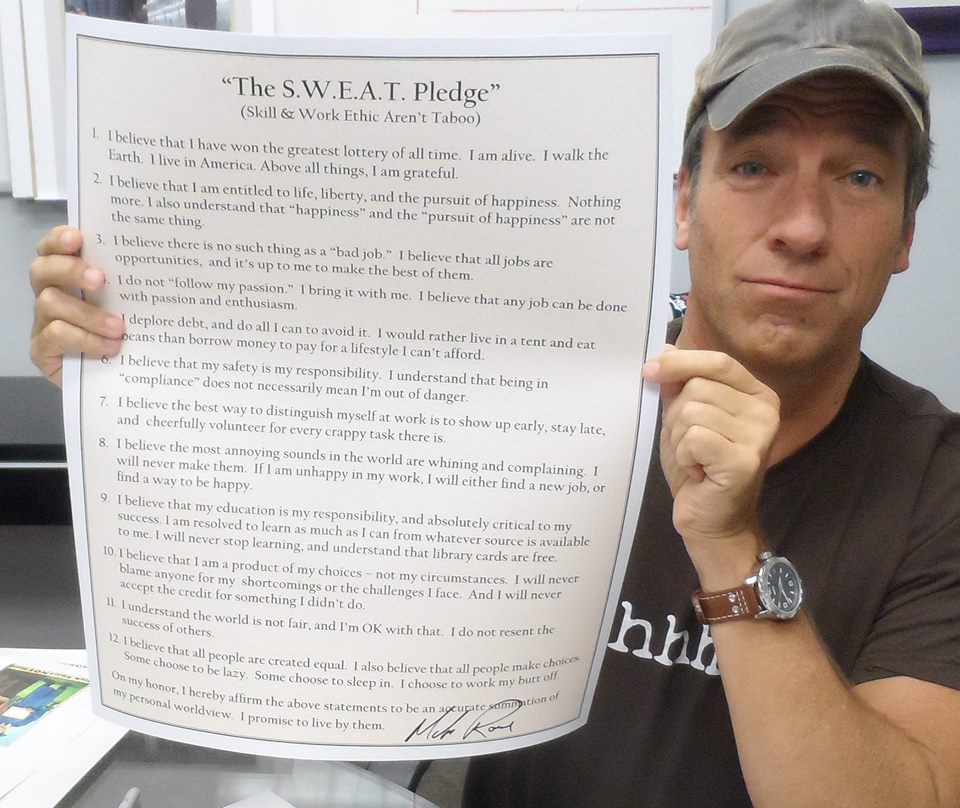
Ladies and gentlemen, today we present to you “The S.W.E.A.T. Pledge,” by Mike Rowe himself. Rowe crafted and shared it on his Facebook page this week and says he wrote The Pledge last year for three simple reasons:

1. I believe what it says, and felt strongly the world needs one more acronym.

2. I wanted to raise some money for the scholarship fund. (We sell them for $10, and the money goes to the foundation.)

3. I needed something declarative that everyone must sign who applies for a mikeroweWORKS Scholarship. Something that reflected my own view of work-ethic and personal responsibility.

This inspiring and uplifting Pledge reads as follows…

the-sweat-pledge

“THE S.W.E.A.T. PLEDGE”

(Skill & Work Ethic Aren’t Taboo)

1. I believe that I have won the greatest lottery of all time. I am alive. I walk the Earth. I live in America. Above all things, I am grateful.

2. I believe that I am entitled to life, liberty, and the pursuit of happiness. Nothing more. I also understand that “happiness” and the “pursuit of happiness” are not the same thing.

3. I believe there is no such thing as a “bad job.” I believe that all jobs are opportunities, and it’s up to me to make the best of them.

4. I do not “follow my passion.” I bring it with me. I believe that any job can be done with passion and enthusiasm.

5. I deplore debt, and do all I can to avoid it. I would rather live in a tent and eat beans than borrow money to pay for a lifestyle I can’t afford.

6. I believe that my safety is my responsibility. I understand that being in “compliance” does not necessarily mean I’m out of danger.

7. I believe the best way to distinguish myself at work is to show up early, stay late, and cheerfully volunteer for every crappy task there is.

8. I believe the most annoying sounds in the world are whining and complaining. I will never make them. If I am unhappy in my work, I will either find a new job, or find a way to be happy.

9. I believe that my education is my responsibility, and absolutely critical to my success. I am resolved to learn as much as I can from whatever source is available to me. I will never stop learning, and understand that library cards are free.

10. I believe that I am a product of my choices – not my circumstances. I will never blame anyone for my shortcomings or the challenges I face. And I will never accept the credit for something I didn’t do.

11. I understand the world is not fair, and I’m OK with that. I do not resent the success of others.

12. I believe that all people are created equal. I also believe that all people make choices. Some choose to be lazy. Some choose to sleep in. I choose to work my butt off.

Hope this inspires you today!

Photo Credit: Mike Rowe


Wednesday, June 18, 2014

13 things mentally strong people don’t do

13 things mentally strong people don’t do

Mentally strong people have healthy habits. They manage their emotions, thoughts, and behaviors in ways that set them up for success in life. Check out these things that mentally strong people don’t do so that you too can become more mentally strong.

1. They don’t waste time feeling sorry for themselves
Mentally strong people don’t sit around feeling sorry about their circumstances or how others have treated them. Instead, they take responsibility for their role in life and understand that life isn’t always easy or fair.

2. They don’t give away their power
They don’t allow others to control them, and they don’t give someone else power over them. They don’t say things like, “My boss makes me feel bad,” because they understand that they are in control over their own emotions and they have a choice in how they respond.

3. They don’t shy away from change
Mentally strong people don’t try to avoid change. Instead, they welcome positive change and are willing to be flexible. They understand that change is inevitable and believe in their abilities to adapt.

4. They don’t waste energy on things they can’t control
You won’t hear a mentally strong person complaining over lost luggage or traffic jams. Instead, they focus on what they can control in their lives. They recognize that sometimes, the only thing they can control is their attitude.

5. They don’t worry about pleasing everyone
Mentally strong people recognize that they don’t need to please everyone all the time. They’re not afraid to say no or speak up when necessary. They strive to be kind and fair, but can handle other people being upset if they didn’t make them happy.

6. They don’t fear taking calculated risks
They don’t take reckless or foolish risks, but don’t mind taking calculated risks. Mentally strong people spend time weighing the risks and benefits before making a big decision, and they’re fully informed of the potential downsides before they take action.

7. They don’t dwell on the past
Mentally strong people don’t waste time dwelling on the past and wishing things could be different. They acknowledge their past and can say what they’ve learned from it. However, they don’t constantly relive bad experiences or fantasize about the glory days. Instead, they live for the present and plan for the future.

8. They don’t make the same mistakes over and over
Mentally strong people accept responsibility for their behavior and learn from their past mistakes. As a result, they don’t keep repeating those mistakes over and over. Instead, they move on and make better decisions in the future.

9. They don’t resent other people’s success
Mentally strong people can appreciate and celebrate other people’s success in life. They don’t grow jealous or feel cheated when others surpass them. Instead, they recognize that success comes with hard work, and they are willing to work hard for their own chance at success.

10. They don’t give up after the first failure
Mentally strong people don’t view failure as a reason to give up. Instead, they use failure as an opportunity to grow and improve. They are willing to keep trying until they get it right.

11. They don’t fear alone time
Mentally strong people can tolerate being alone and they don’t fear silence. They aren’t afraid to be alone with their thoughts and they can use downtime to be productive. They enjoy their own company and aren’t dependent on others for companionship and entertainment all the time but instead can be happy alone.

12. They don’t feel the world owes them anything
Mentally strong people don’t feel entitled to things in life. They weren’t born with a mentality that others would take care of them or that the world must give them something. Instead, they look for opportunities based on their own merits.

13. They don’t expect immediate results
Whether they are working on improving their health or getting a new business off the ground, mentally strong people don’t expect immediate results. Instead, they apply their skills and time to the best of their ability and understand that real change takes time.

Credits: LifeHack, where this was originally featured.


13 things mentally strong people don’t do

13 things mentally strong people don’t do

Mentally strong people have healthy habits. They manage their emotions, thoughts, and behaviors in ways that set them up for success in life. Check out these things that mentally strong people don’t do so that you too can become more mentally strong.

1. They don’t waste time feeling sorry for themselves
Mentally strong people don’t sit around feeling sorry about their circumstances or how others have treated them. Instead, they take responsibility for their role in life and understand that life isn’t always easy or fair.

2. They don’t give away their power
They don’t allow others to control them, and they don’t give someone else power over them. They don’t say things like, “My boss makes me feel bad,” because they understand that they are in control over their own emotions and they have a choice in how they respond.

3. They don’t shy away from change
Mentally strong people don’t try to avoid change. Instead, they welcome positive change and are willing to be flexible. They understand that change is inevitable and believe in their abilities to adapt.

4. They don’t waste energy on things they can’t control
You won’t hear a mentally strong person complaining over lost luggage or traffic jams. Instead, they focus on what they can control in their lives. They recognize that sometimes, the only thing they can control is their attitude.

5. They don’t worry about pleasing everyone
Mentally strong people recognize that they don’t need to please everyone all the time. They’re not afraid to say no or speak up when necessary. They strive to be kind and fair, but can handle other people being upset if they didn’t make them happy.

6. They don’t fear taking calculated risks
They don’t take reckless or foolish risks, but don’t mind taking calculated risks. Mentally strong people spend time weighing the risks and benefits before making a big decision, and they’re fully informed of the potential downsides before they take action.

7. They don’t dwell on the past
Mentally strong people don’t waste time dwelling on the past and wishing things could be different. They acknowledge their past and can say what they’ve learned from it. However, they don’t constantly relive bad experiences or fantasize about the glory days. Instead, they live for the present and plan for the future.

8. They don’t make the same mistakes over and over
Mentally strong people accept responsibility for their behavior and learn from their past mistakes. As a result, they don’t keep repeating those mistakes over and over. Instead, they move on and make better decisions in the future.

9. They don’t resent other people’s success
Mentally strong people can appreciate and celebrate other people’s success in life. They don’t grow jealous or feel cheated when others surpass them. Instead, they recognize that success comes with hard work, and they are willing to work hard for their own chance at success.

10. They don’t give up after the first failure
Mentally strong people don’t view failure as a reason to give up. Instead, they use failure as an opportunity to grow and improve. They are willing to keep trying until they get it right.

11. They don’t fear alone time
Mentally strong people can tolerate being alone and they don’t fear silence. They aren’t afraid to be alone with their thoughts and they can use downtime to be productive. They enjoy their own company and aren’t dependent on others for companionship and entertainment all the time but instead can be happy alone.

12. They don’t feel the world owes them anything
Mentally strong people don’t feel entitled to things in life. They weren’t born with a mentality that others would take care of them or that the world must give them something. Instead, they look for opportunities based on their own merits.

13. They don’t expect immediate results
Whether they are working on improving their health or getting a new business off the ground, mentally strong people don’t expect immediate results. Instead, they apply their skills and time to the best of their ability and understand that real change takes time.

Credits: LifeHack, where this was originally featured.


Thursday, June 12, 2014

KRISTEN FINDS LIFE IN THE MIDST OF SUICIDE ATTEMPT

Kristen Anderson found hope and life in the face of death, rape, shame, and depression.  She wanted death but found life instead. 

Tuesday, June 10, 2014

ANGER: THE SKELETON AT THE FEAST IS YOU

"Of the Seven Deadly Sins, anger is possibly the most fun. To lick your wounds, to smack your lips over grievances long past, to roll over your tongue the prospect of bitter confrontations still to come, to savor to the last toothsome morsel both the pain you are given and the pain you are giving back--in many ways it is a feast fit for a king. The chief drawback is that what you are wolfing down is yourself. The skeleton at the feast is you."

Monday, June 09, 2014

Jim Caviezel’s Message To People Who’ve Had Abortions

What Jim Caviezel Said To People Who Have Had Abortions Made Him Break Down And Weep.

Submitted by:  Veronica Coffin

0

When actor Jim Caviezel sat down in front of the congregation at Rock Church, they had no idea what was about to hit them. During the 40 minute interview session, Caviezel repeatedly went off script, passionately exhorting his listeners not to be happy with mediocrity, but to take Christ seriously.

But he was never more passionate than when he spoke about abortion. By the end of this four minute clip, Caviezel is literally weeping, as he reminds his audience of the infinite mercy of God, assuring his listeners that Christ is waiting to accept them, if only they say “yes.” An unbelievable speech from an amazing actor.

Jim Caviezal speaks with Dave Cooper. Listen to his story and message – it is one for us all…


Sunday, June 08, 2014

A 'product of rape,' Miss USA hopeful now educates on sexual assault

A 'product of rape,' Miss USA hopeful now educates on sexual assault

people
Adrienne Mand LewinTODAY contributor

June 5, 2014 at 9:50 AM ET

Miss Pennsylvania Valerie Gatto

Courtesy of Valerie Gatto

Miss Pennsylvania USA Valerie Gatto, competing in the Miss USA beauty pageant on June 8, educates women about protecting themselves from sexual assault.

Miss Pennsylvania Valerie Gatto, 24, a self-described “product of rape,” hopes her experience growing up as well as her mother’s attack can show that anything is possible from a bleak starting point. Gatto also educates women about protecting themselves from sexual assault.

“I haven’t just been preparing for Miss USA for five months. It’s been my entire life,” Gatto, a marketing consultant, told TODAY.com. “Being a child of a rape, not knowing who my father is, not knowing if he’s ever been found, most people would think it’s such a negative situation.

“I grew up with my mom and my grandparents. They never looked at it as something negative. I have a loving, supportive family who told me I could be the president of the United States.”

Valerie Gatto poses with her grandparents.

Courtesy of Valerie Gatto

Valerie Gatto poses with her grandparents, who helped raise her.

Gatto hopes to win the Miss USA title in order to better help spread the word on sexual assault awareness.

Valerie Gatto

Gatto, at her alma mater the University of Pittsburgh, hopes to win the Miss USA title to help spread sexual assault awareness.

The 2014 Miss USA Competition will air live from Baton Rouge, La., at 8:00 p.m. Sunday on NBC. Gatto is one of 51 candidates, representing each state and the District of Columbia, who will be evaluated in swimsuit, evening wear and interview categories.

Gatto harbored an early interest in pageants: When she was 4 years old, an advertisement for a beauty pageant arrived in the mail featuring her then- idol, “Saved by the Bell” actress Tiffani Amber Thiessen. Without a thought, Gatto’s mother tossed the mailer in the trash.

But Gatto was having none of it — she retrieved the number, called it herself and begged her mom to allow her to participate in the contest, which was clear across the state in Valley Forge, Pa. Her passion paid off, and Gatto's mom let her participate.

It is that determination that she hopes will win her the Miss USA title and also help others. “I believe God put me here for a reason: to inspire people, to encourage them, to give them hope that everything is possible and you can’t let your circumstances define your life.”

Gatto began asking questions about her father when she was young. In third grade, she was told the version appropriate for someone her age: “Something bad happened to me. A very bad man hurt me but God gave me you.”

A photo of Miss Pennsylvania Valerie Gatto and her mother.

Courtesy of Valerie Gatto

A photo of Miss Pennsylvania Valerie Gatto and her mother.

She said her mother was a 19-year-old coming out of work on a busy Pittsburgh street when a man dressed in black attacked her at knifepoint and raped her behind some buildings. When he was spooked by a passing car with its high beams on, she managed to get away. She uses her mother’s example as a teaching point, speaking to young women 18 to 30 about sexual assault awareness.

“Unfortunately, we have to be aware of these crimes,” Gatto said. “I hope to show others how to be proactive, what to do, to be present, to be aware of your surroundings, little things like that … I’m educating women about a topic that’s so serious, but it’s so awesome to see their responses. They say it changes their life.”

Gatto addresses younger students about setting goals and achieving dreams and teaches college-age women about how to protect themselves. She has participated in the International Men’s March to stop rape, sexual assault and gender violence.

Miss Pennsylvania hopes a Miss USA title would give her a larger platform to reach more people. “Being a voice is life-changing, and I just want to keep going,” she said. “I’m not sharing this story for publicity. I’m not doing this for any selfish reasons. I truly am doing this to change the world and make a difference.”

And she believes it’s a done deal. “Losing is not an option,” she said. “In my mind, I believe that I’m already Miss USA.”


Sent from my iPhone

Monday, June 02, 2014

GRATEFUL AROUND THE WORLD

"All that I am, all that I see, all that I've been and all that I'll ever be is a blessing, it's so amazing and I'm grateful for it all..."

Watch this amazing video to the end. 

Nov 26, 2013 "Musicians Nimo Patel and Daniel Nahmod brought together dozens of people from around the world to create this beautiful, heart-opening melody. Inspired by the 21-Day Gratitude Challenge, the song is a celebration of our spirit and all that is a blessing in life. For the 21 Days, over 11,000 participants from 118 countries learned that "gratefulness" is a habit cultivated consciously and a muscle built over time. As a famous Roman, Cicero, once said, "Gratitude is not only the greatest of virtues, but the parent of all others." This soul-stirring music video, created within a week by a team of volunteers, shines the light on all the small things that make up the beautiful fabric of our lives.

Visit at:

Emptyhandsmusic.com (Nimo Patel)
KindSpring.org
DanielNahmod.com
EllieWalton.com

Tuesday, May 27, 2014

Saturday, May 24, 2014

EVAN MERCER, DEAF VELADICTORIAN

Evan Mercer is deaf. It didn't stop him from defying expectations, becoming valedictorian, and delivering an amazing speech.

COBB COUNTY, Ga-- Evan Mercer was born deaf, but it wasn't discovered until he was four years old. Specialists told his parents he would never read, and speaking was out of the question. Evan defied the prediction in his valedictorian speech at Harrison High School May 22nd.

"Deafness has taught me to never give up," he said from the stage. "Not when experts tell you it can't be done. Not when you've fallen so far behind, quitting seems the only way out. Not when achieving your dreams seems an absolute impossibility."

Evan told the crowd it took him seven years to say a simple three-word sentence. "Understand and quitting is easy," he said. "It's also permanent."

His speech is full of wisdom out of place in a high school auditorium.

"If you want something, refuse to allow the skeptics to poison it."

"Find your own impossible and bring it to its knees."

"Reject the idea that these are the best years of your life," he said. "My best year is going to be the last year of my life, whenever that may be."

Maybe most amazing is that this isn't a one-time viral video. Evan has been working in the community, defying expectations for years. He won a scholarship with 11Alive's Kids Who Care program for his work building outdoor classrooms and working with young deaf children.

"I want to improve lives," he told 11Alive after the nomination. "I think if I can improve hearing, people who have hearing disabilities, I think it will be a huge improvement in their lives."

That giving back started a long time ago and stretched through graduation night when he gave everyone in that audience a little piece of awe.


Friday, May 23, 2014

Sir Nicholas Winton at 105: the man who saved 669 Czech childre


Sir Nicholas Winton at 105: the man who gave 669 Czech children the 'greatest gift'

By Anita Singh, Arts and Entertainment Editor, video by Heathcliff O'Malley7:04AM BST 21 May 2014

• Read extracts from Barbara Winton's book about her father's heroic story

Reaching the age of 105 would be enough to mark most people out as remarkable. For Sir Nicholas Winton, it is the least of his achievements.

Related Articles

The British hero who saved 669 Jewish children from the Holocaust celebrated his birthday with the news that he is to receive the Czech Republic’s highest honour.

Sir Nicholas will be awarded the Order of the White Lion, the country’s most revered state distinction, for giving Czech children “the greatest possible gift: the chance to live and to be free”.

Sir Nicholas Winton on his 105th birthday

Sir Nicholas Winton on his 105th birthday (HEATHCLIFF O'MALLEY FOR THE TELEGRAPH)

The Czech president, Milos Zeman, wrote to Sir Nicholas: “Your life is an example of humanity, selflessness, personal courage and modesty.”

In 1939, Sir Nicholas masterminded the transportation of children from Nazi-occupied Czechoslovakia to Britain, saving them from the concentration camps.

He rarely spoke of his achievements in the decades that followed, believing his actions to be unremarkable.

He came to public attention only in 1988, when he was reunited with some of those who call themselves “Nicky’s Children” on an emotional episode of the BBC programme That’s Life!

He was knighted by the Queen in 2003.

Sir Nicholas has outlived many of those he saved, and looked positively sprightly at the Czech Embassy on Monday night as he was presented with a cake bearing 105 candles.

"As far as I’m concerned, it’s only anno domini that I’m fighting. I’m not ill, I’m just old and doddery – more doddery than old, actually,” he said. Sir Nicholas insisted on standing to deliver his speech.

He attributes his longevity to good genes and staying active. When undergoing a hip replacement at the age of 103, doctors asked him if he would want to be resuscitated in the event that his heart stopped on the operating table. He was incredulous.

Sir Nicholas Winton with his daughter Barbara

Sir Nicholas Winton with his daughter Barbara (HEATHCLIFF O'MALLEY FOR THE TELEGRAPH)

“Resuscitate me, of course! I want to live!” he said.

His daughter, Barbara Winton, recalled: “Last year when I half-heartedly suggested that perhaps having a party every year was a bit too much, his reply was that, as he didn’t know when the last one would be, he intended to keep having them.”

Sir Nicholas was a 29-year-old stockbroker about to set off on a skiing holiday in December 1938 when a friend urged him to change his plans and visit Prague. A politically-minded young man, he agreed to go in order to witness what was happening in the country.

The Nazis had invaded the Sudetenland two months earlier and the situation in Prague was becoming increasingly dangerous for Jews.

While agencies were organising the mass evacuation of children from Austria and Germany, there was no such provision in Czechoslovakia.

Sir Nicholas began meeting parents who were desperate for their children to be taken to a place of safety, and began compiling a list of names.

Sir Nicholas Winton with some of those he saved as children from the Nazis in an operation later known as the Czech Kindertransport

Sir Nicholas Winton with some of those he saved as children from the Nazis in an operation later known as the Czech Kindertransport (HEATHCLIFF    O'MALLEY )

The first train left Prague on March 14, the day before German troops marched into Czechoslovakia. Two fellow volunteers, Trevor Chadwick and Doreen Warriner, organised the Prague end of the operation.  

Sir Nicholas returned to Britain and masterminded the rescue mission, finding adoptive homes for the children, pleading for funds and navigating the complex bureaucracy – ensuring each child had the £50 guarantee (£2,500 in today’s money) to pay for their eventual return, and securing exit and entry permits.

On some occasions, he forged Home Office documents which had been too slow to arrive, and without which the children would not have been allowed to leave Czechoslovakia.

Name tags around their necks, the bewildered children arrived at Liverpool Street Station where Sir Nicholas and his mother would greet them. Some had relatives in the UK, but most went to live with strangers.

Sir Nicholas Winton photographed in 1942 with his brother and sister in Hampstead

Sir Nicholas Winton photographed in 1942 with his brother and sister in Hampstead

Eight trains reached London. The ninth did not. It had been set to leave on September 1, carrying 250 children – the largest number yet. But that day Germany invaded Poland, and all borders were closed.

Those who arrived at the station were turned away by German soldiers. It is thought that nearly all the children due to leave that day ended up in the concentration camps. Some were siblings of children who had made it out on earlier trains.

An estimated 6,000 people across the world are descendants of ‘Nicky’s Children’.

Guests at the birthday celebration included Lord Dubs, the Labour peer who was six when his mother put him on one of the Kindertransport trains. He was also one of the lucky ones – his parents both survived the war, although other family members perished in Auschwitz.

“Most of the children never saw their parents again so I was exceptional. Don’t put me down as typical,” Lord Dubs said.

“I can still see Prague station – the children, the parents, the soldiers with swastikas. We set off and when the next evening we got to Holland, all the older ones cheered because we were out of reach of the Nazis. I didn’t fully understand.

“It wasn’t until many years later that I understood what had happened and discovered all about Nicholas. When you meet somebody who almost certainly saved your life, it’s very emotional. I didn’t quite know how to handle it.

"I owe my life to him.”

Alf Dubs, a Labour Peer, was one of the children saved by Sir Nicholas Winton (rt)

Alf Dubs, a Labour Peer, was one of the children saved by Sir Nicholas Winton (HEATHCLIFF O'MALLEY FOR THE TELEGRAPH)

Others rescued by the Czech Kindertransport include Karel Reisz, director of Saturday Night and Sunday Morning and The French Lieutenant’s Woman, and Joe Schlesinger, the Canadian television journalist.

Sir Nicholas has always maintained that anyone in his position would have done the same. He dislikes being termed ‘The British Schindler’, pointing out that those who ran the mission from the Prague end took far greater risks with their own safety.  

His achievements would have gone unheralded were it not for a scrapbook which he had kept. It contained pictures, documents, letters and photos from the mission, and a list of the children saved.

A family friend passed the scrapbook to a newspaper in 1988 and the story was taken up by That’s Life!, the consumer programme hosted by Esther Rantzen.

Sir Nicholas, then 78, was invited on to the show and, in a moving sequence, found himself seated in an audience made up of those who owed their lives to him.

His involvement with the victims of the Nazis did not end with the Kindertransport.

In 1947, he began work for the International Refugee Organisation, part of the United Nations. His role was to supervise the disposal of items looted by the Nazis and recovered by the Allies.

An undated handout  of  Nicholas Winton with one of the children he rescued: Nicholas Winton

An undated handout of Nicholas Winton with one of the children he rescued: Nicholas Winton (PA)

Amongst the jewellery, furs, china and artworks were horrific reminders of the fate that had befallen so many Jews: crates of false teeth and reading glasses; gold fillings removed from corpses in the gas chambers.

Sir Nicholas’s job involved photographing and sorting these items into those that could be sold at auction – with the money going to help people displaced by the war - and those which were deemed financially worthless.

The latter were disposed of at sea, in a ceremony overseen by Sir Nicholas. He was keenly aware that each “worthless” item was a part of someone’s history, but had no way of tracing ownership.

His last undertaking was to see the gold jewellery melted down into bars, which he brought to London.

A matter-of-fact telegram sent by Sir Nicholas to his boss in February 1948 notes the solemn nature of the task.

“Many months work… culminated today my arrival London with kilograms 650 gold    formerly gold teeth etcetera sold for approx. sevenhundred thousand dollars stop This ends one chapter concentration camps and opens new one for resettlement survivors nazi terror stop”

Sir Nicholas has said of the disposal: “I think not only of all those innocent lives, senselessly and horrifically cut off, most of them in their prime, but of the depraved minds obsessed with the material gains to be obtained from pitiable items so small and so personal as gold fillings.”

He devoted his later years to working for charity, including the Abbeyfield organisation which provides care for the elderly. Some years ago a chance conversation uncovered the fact that one of his fellow trustees was the son of a child Sir Nicholas had saved.

His extraordinary life has been chronicled in a biography, written by his daughter, Barbara. If It’s Not Impossible… The Life of Nicholas Winton takes its title from his motto: “If something is not impossible, then there must be a way to do it.”

Czech Kindertransport founder Sir Nicholas Winton speaks to media at his home in Maidenhead

Czech Kindertransport founder Sir Nicholas Winton speaks to media at his home in Maidenhead (PA)

She said of her father: “What he did in 1939 wasn’t out-of-character. It was typical of the kind of impulses he has when he sees a situation and thinks it should be rectified.”

In the book, Barbara writes: “My father’s wish for his biography, having agreed to me writing it, is that it should not promote hero worship or the urge for a continual revisiting of history, but if anything, that it might inspire people to recognise that they too can act ethically in the world and make a positive difference to the lives of others in whatever area they feel strongly about, whether it be international crises or nearer to home, in their own community.

“If reading his story about the rescue of the children causes people to think, ‘What a hero. I could never do anything like that. It’s much too difficult and anyway, heroes like that were on needed in remote history when we were at war. Now let me get on with my life,’ he is not that interested.

“But if reading it inspires people to think, ‘Well, things are not right in the world now. I can make a difference in my own way and I am going to do it,’ then he will be a happy man.”

Sir Nicholas’s parents were Jewish but not religious, and had him baptised as a Christian as a way of integrating into British life. He now describes himself as agnostic.

Asked what message he would like the biography to carry, Sir Nicholas told his daughter: “I came to believe through my life that what is important is that we live by the common ethics of all religions – kindness, decency, love, respect and honour for others – and not worry about the aspects within religion that divide us.”

If It’s Not Impossible: The Life of Sir Nicholas Winton, by Barbara Winton (published by Troubador) is on sale for £12.99 at troubador.co.uk

Barbara Winton will be speaking to Simon Schama and Philippe Sands at the    Hay Festival on May 27 at 10am. For tickets, visit hayfestival.com/boxoffice


Sent from my iPhone

Saturday, May 17, 2014

MUSLIM FINDS JESUS DURING PILGRIMAGE TO MECCA

Copied from the following link:

MUSLIM FINDS JESUS DURING PILGRIMAGE TO MECCA

Pastor Ali Pektash

By Israel Today/Charles Gardner

A Turkish Muslim who made a pilgrimage to Mecca in a desperate attempt to get his life back on track returned as a Christian to the great astonishment of his family.

Now a pastor, Ali Pektash has been addressing a conference in Jerusalem called At the Crossroads, and sees it as part of his mission to help re-unite the sons of Abraham.

Ali, a Kurd, suffered from alcohol addiction when friends persuaded him to make Hajj (pilgrimage) to Islam’s holy city. It was in Saudi Arabia, where liquor is banned, and the religious ritual might cure him, they suggested.

When he got there, he cried out to God for help (if indeed He was there) and fell asleep.

Jesus then appeared to him in a dream and touched him, saying: “You believe in me now; leave this place.”

After taking a shower next morning, he discovered what he thought was dust on the part of his chest Jesus had touched, but in fact the hair on his chest had turned white in the shape of a hand! At the traditional celebration marking his return from Hajj, he announced to his incredulous family that he had seen Jesus in Mecca and had come back a Christian.

He burst out crying in front of his wife and asked forgiveness for the way he had treated her, clearly demonstrating a dramatic change in his life.

But for three years he had no access to a Bible and it was seven years before he met another Turkish Christian.

He eventually started a church in Ankara, the capital, which he has recently handed over to trusted elders in order to begin a new work in Eastern Turkey, where he was raised.

At the Crossroads, hosted at Christ Church in the heart of Jerusalem’s Old City, is aimed at deepening the bonds of reconciliation between Arab Christians and Jewish followers of Jesus and is being attended by delegates from a number of Middle East countries including Iran, Egypt, Cyprus and Jordan.

Speaking in Turkish (translated through headsets for those who needed it), Ali spoke of how Abraham was also his ancestor, and how he saw it as part of his mission to help re-unite the children of Isaac and Ishmael (Abraham’s children by different wives).

Illustrating how family division can cause lasting conflict among the children affected, he said it was no different for the descendants of Abraham who continue to be embroiled in much strife and contention with each other.

But now it was time for reconciliation. “We have a very important ministry – to reconcile the world,” he said.

But it could only be done through Jesus. “Everybody in Turkey says they believe in God,” he said. “But people are persecuting me!”

In a further example of reconciliation, a Palestinian delegate from Hebron (where Abraham is buried) said: “I was one of those who hated the Jews, but Jesus changed my life.”

A number of Israeli pastors responded by laying hands on him in prayer and offering words of encouragement.

Speaking for myself, I was profoundly moved when during a communion service the previous night I was surrounded by a Turk, Egyptian, Iranian, Armenian and an Israeli originally from South Africa.

History is still being made in Israel today — don’t miss it. Subscribe to “Israel Today.”

Although there was a language barrier in some cases, we embraced each other without words during the traditional “peace” greeting that immediately precedes the sharing of bread and wine.

The conference – including worship sessions – is also being held in English, Hebrew and Arabic.

The Power Of Music For Health

Copied from the following link:

There was one aspect of my childhood that was especially lucky. My parents insisted that I learn how to play a musical instrument at a young age. I think that eventually I would have played an instrument in any case. Music, in my gene pool, seems to be a genetic disease (but a good one).

Still, without my parents early prodding, I might not have started playing music as early I did. And I might not have been as disciplined in my musical endeavors if I hadn’t been trained in elementary school.

My mother had been a professional pianist and music teacher, and she just took it for granted that every kid should learn music. But I’m sure she never considered the health benefits of music.

Variety Show

For just about anyone with a computer, the expansion of the Internet has bestowed unprecedented access to a mind-blowing variety of different types of music. Browsing among selections on websites like YouTube, I sometimes think a dedicated music lover could tune into most of the music written during the past 300 years.

My personal obsession with music extends to playing a number of instruments. Maybe I don’t play any particular instrument that well; but I find that emotionally and physically, playing for a while every day on the guitar or piano just plain makes me feel better.

And research into the effects of music — listening to it and performing it — shows that the activity produces measureable health benefits.

Brain Help

When scientists at the University of Liverpool measured changes in blood flow in people’s brains after taking music lessons, they found that a single lesson, even for just half an hour, shuttles more blood into the left hemisphere of the brain. That suggests that doing music activates the part of the brain that takes part in both music and language.

The probable conclusion: Singing and playing music may improve your language skills.

According to researcher Amy Spray: “The areas of our brain that process music and language are thought to be shared and previous research has suggested that musical training can lead to the increased use of the left hemisphere of the brain.”

Exercise To Music

Other researchers have found that listening to music while you exercise can improve your brain function significantly.

In a study at Ohio State University, scientists decided to see what kind of effect exercise and music would have on patients with heart disease. As researcher Charles Emery notes, “Evidence suggests that exercise improves the cognitive performance of people with coronary artery disease. And listening to music is thought to enhance brain power. We wanted to put the two results together.”

When they had heart patients walk or run on a treadmill, the researchers found that the 33 participants in the study reported improvements in their moods and mental outlook whether they listened to music or not. But their improvement on verbal fluency tests after listening to classical music while exercising was more than double what they could do without music.

“Exercise seems to cause positive changes in the nervous system, and these changes may have a direct effect on cognitive ability,” Emery says. “Listening to music may influence cognitive function through different pathways in the brain. The combination of music and exercise may stimulate and increase cognitive arousal while helping to organize cognitive output.”

Musical Benefits

If you don’t have a lot of music in your life, now’s the time to put this activity to work to boost the health of your body and brain. Even if you just listen and you don’t play, you can benefit.

And it doesn’t hurt to sing along.

Other research indicates that:

  • Musical training keeps your brain younger as you age. A study at Northwestern showed that people who receive early musical training do better on brain tests as they grow older. This benefit persists even if you haven’t played much music since your early years.
  • Listening to your favorite music can lower your blood pressure. Research at New Westminster College in Canada shows that when heart patients listen to music they enjoy, their blood vessels relax and function more efficiently. The music produces measureable improvement in relaxation of vessel walls.
  • Listening to religious music you like can improve your mental health. When scientists from the University of Texas-San Antonio studied older adults who listen to religious music, they found that these seniors enjoy more life satisfaction and less anxiety.

Morning Music

Years ago, when I was still living with my parents, my father used to listen to a news radio station every morning. Talk about irritating. I can still hear the tinny voice on that radio speaker telling everyone within earshot to pay attention to the weather and traffic on the eights.

Nowadays, when I get ready for work in the morning, the news is about the last thing I want to hear. Instead I listen to music. And even if researchers hadn’t confirmed that music fine tunes your health, I’d still have a healthy appetite for a bounty of bouncy tunes.